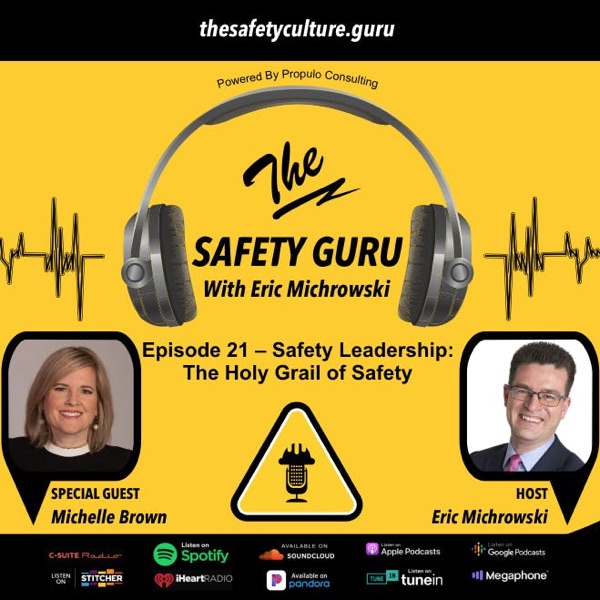
Safety Leadership: The Holy Grail of Safety with Michelle Brown
Host Eric Michrowski talks with Michelle Brown, COO of leadership assessment platform Pinsight and professor at the University of Denver, about what separates leaders who transform safety culture from those who merely manage it. Brown, a clinical psychologist by training, argues that safety leadership effectiveness is passion multiplied by skill: leaders need a personal why for safety plus learnable transformational leadership behaviors. The conversation covers role modeling, storytelling instead of spreadsheets, and turning safety conversations into organizational habits.
Key takeaways
- The effectiveness of safety leadership is an equation: your personal why for safety multiplied by leadership skill. You need both.
- Leadership skills are learnable, like riding a bike or a language, but without a driving why leaders rarely invest in developing them.
- Inconsistent, fair weather safety leaders do not get mediocre outcomes; they get poor outcomes, because crews read them as ingenuine.
- Check your calendar every week and deliberately block time for leading; safety walks squeezed in at 4:30 on Friday do not get it done.
- Role model the behaviors you want even when nobody is watching; one blown stop sign can undo everything a leader says in meetings.
- Humans transmit meaning through stories, not spreadsheets; start every safety message with why it matters to the listener.
- Replace binary questions like how many observations have you done with thinking questions like what concerned you and where will the next injury happen.
Safety leadership and safety management was very rarely done with a pen or a policy, but it was their words and their actions.
The good news is that you have more power than you think, and the bad news is that you have more power than you think.
Safety is like health. You don't just jump on the treadmill once a year and say, well, that's it, I'm good, I'm healthy now.
What interests my boss fascinates me.
The SafetyTalker take
The most usable idea here is the calendar audit: count the leading opportunities you actually have this week and plan how you want to show up to each one. Pair that with Brown's question swap. Asking a crew what concerned them in their last observation forces real thinking in a way that counting observation cards never will.
Michelle Brown started her career as a clinical psychologist working with children and families, then spent 11 years applying the same relationship psychology to safety leadership in heavy industry. By the time of this conversation she was COO of Pinsight, a leadership assessment platform, and a professor at the University of Denver. Host Eric Michrowski calls her one of the most influential thinkers on safety leadership he has met, and this episode shows why: it turns the vague demand to “lead safety” into a set of concrete, learnable behaviors.
Passion times skill
Brown’s core model is an equation: the effectiveness of a safety leader equals their why multiplied by their skill. The why is personal. For some leaders it comes from a traumatic event, like the CEO Michrowski describes who could relive, step by step, the drive to tell an employee’s wife that her husband was not coming home. But Brown is clear that you do not need to walk through fire to find a why. A deep desire to make people’s lives better works too, and it fuels the consistency that separates real leaders from those who only show up during safety week or after an incident.
The skill side is the encouraging part. Brown insists leadership skills are like riding a bike or learning a language: anyone can build them with focus and practice. What you cannot script is the drive. Michrowski puts it bluntly: you might learn the words like an actor, but you cannot fake the passion behind your actions. That connects directly to why crews notice when a supervisor genuinely means it about working safe versus reading from a script.
Why mediocre leadership gets poor results
One research finding in the episode deserves a spot on every leadership slide: great leaders produce great safety outcomes, poor leaders produce poor outcomes, and mediocre, wishy-washy leaders who dabble in safety leadership inconsistently also produce poor outcomes, not mediocre ones. People experience them as inconsistent and ingenuine. Brown’s field interviews are full of the same story: a leader speaks about safety at a meeting, then blows through the stop sign leaving the office, and the crew concludes that everything the leader says is nonsense.
The fix is deliberate role modeling. Wear your PPE consistently. Make safe behavior part of who you are, even when nobody is watching. And audit your calendar: Brown tells leaders to check every week how many leading opportunities they have, from meetings to task reviews, and to plan how they want to show up rather than getting caught short on Friday afternoon with a rushed safety walk and a couple of pats on the back. Michrowski adds data from one organization during the pandemic: leaders who already spent significant time on the floor kept finding ways to connect, while those below 40 percent found excuses to stop.
Stories beat spreadsheets
The section on communication is the most practical in the episode. Humans transmit meaning through stories, Brown argues, not through graphs, stats or PowerPoint. Nobody recalls a compelling spreadsheet on their deathbed. Borrowing Simon Sinek’s golden circle, she tells leaders to start with why the message matters to the listener, not to themselves. Her own team opens every meeting with two minutes of storytelling about moments where someone lived a core value. It felt like pulling teeth for the first 18 months; now the meeting feels off without it. That is her definition of sustainable leadership: transformational behaviors turned into organizational habits, the same logic behind running a consistent toolbox talk program instead of a once a year stand down.
Michrowski contributes the Paul O’Neill story from Alcoa: after a fatality, the CEO cleared his calendar and showed up not to yell but to ask how the organization was failing. Twenty five years later, that is the story people still tell. Leaders who want that kind of credibility have to be willing to hear uncomfortable news, which is also the foundation that makes stop work authority real rather than a poster on the wall.
Ask questions that make people think
The episode closes with a small change with large effects. Instead of binary questions like “when was your last safety observation,” ask “what did you observe, what concerned you, where do you think the next injury will happen?” Brown loves this because questions engage the neural networks that do risk analysis: synapses that fire together wire together, so repeated thinking conversations literally wire crews for risk awareness. Michrowski caps it with a quote someone shared with him: what interests my boss fascinates me. If your questions show genuine interest in hazards rather than shortcuts and quick answers, that interest cascades down the organization. For more on building that kind of culture day to day, see our guide to improving safety culture in the workplace.
Full transcript
Read the full transcript
Real leaders leave a legacy. They capture the hearts and minds of their teams. Their origin story puts the safety and well-being of their people first. Great companies ubiquitously have safe yet productive operations. For those companies, safety is an investment, not a cost. For the C-suite, it’s a real topic of daily focus. This is The Safety Guru with your host, Eric Michrowski, a globally recognized ops and safety guru, public speaker and author. Are you ready to leave a safety legacy? Your legacy success story begins now.
Eric Michrowski: Hi, and welcome to The Safety Guru. Today I’m very excited to have with me Michelle Brown, who is Chief Operating Officer at Pinsight, one of the leading, most sophisticated platforms for leadership assessments and development that delivers a lot of great leadership essentials for organizations that want to make sure they’ve got really their top talent in the organization. The reason I’ve got Michelle here: she was probably one of the most influential thinkers around safety leadership that I’ve come across over the years, in terms of what she’s pushed, thinking how she’s influenced a lot of leaders. And I wanted to have a conversation with Michelle around leadership and the role of leaders in shaping safety and safety culture. So Michelle, welcome to the show.
Michelle Brown: Thanks so much for having me, Eric. It’s absolutely delightful to be back talking with you, and about a topic I have so much passion for.
Eric Michrowski: So tell me a little bit about that passion, because you got into the safety space a long time ago, touched a lot of leaders across that journey. Tell me about your passion for leaders and for safety.
Michelle Brown: You know, it’s a bit of a funny path, and probably not a linear one. My first career was as a clinical psychologist. I was working in healthcare settings, I was working with mostly children and families, and certainly nothing to do with safety at that point. But what became really clear for me is that incredible relationship, that dynamic between a parent and child. It’s incredibly transformative. Things that the parents do, they say, the way they act has a huge impact on how children behave and grow and develop and think and feel. And over the course of my career in clinical psychology, I had the chance to transition into working in workplaces, bringing a lot of the same fundamentals of psychology and decision making and relationship dynamics. And I just sort of landed, if you will, in working with safety. And what I thought was sort of not a hugely tight connection in the beginning was an 11 year, incredible career working with some extraordinary organizations, some absolutely inspiring leaders. And I had the opportunity to blend that passion for psychology with my absolute fascination in the leadership and team member dynamic.
Eric Michrowski: That’s phenomenal. So you’ve worked with a lot of leaders globally, seen some phenomenal safety leaders. What are some of the key themes that were consistently visible across all those amazing leaders?
Michelle Brown: You know, the amazing ones, the ones that stand out, the ones that I would sort of leave a day of work with and just think, wow, they really get it. I think the thing that I observed with leaders that could have a really incredible impact, that could really shape a culture, that could really move people to think differently and feel differently and behave differently: these are the leaders that were incredibly, I’m going to say, self-aware. When I say they got it, they really understood that their role mattered. That it wasn’t just that they had a position of authority or they were the boss, but I think they really kind of got the awesome power and responsibility of being in a position of leadership, and they took it very seriously. I had a colleague that I used to work with that would tell leaders, you know, the good news is that you have more power than you think, and the bad news is that you have more power than you think. And I think it’s the leaders that were really incredible for me to watch work were the ones that really understood that power and the responsibility for people and their safety.
Eric Michrowski: That’s amazing. So were there any other themes? One of the parts that I’ve noticed, and I know we’ve talked about this before, is the importance of a desire to leave a legacy. There’s a desire to do something with that power, that ability that I’ve got to shape other people’s lives. Was there something there as well?
Michelle Brown: Yeah. When we would come together and work together and talk about those leaders that we just had such optimism for, their journey and their ability to create change, often it was because they would start at the core of people. I can list off some extraordinary leaders that I’ve had the ability to sit with and work with and support, and they always talked about their love of people. They really understood that safety, that people’s ability to work, to go to work, to do good work, to feel productive, feel engaged, and to be harm free at the end of it, was really starting at their desk. That safety leadership and safety management was very rarely done with a pen or a policy, but it was their words and their actions. And when they got that, and they could really understand that their words and actions were going to make a big difference, many of them really wanted to harness that power. They wanted to do good with that power. And some of those leaders were coming from positions where they really had been confronted with either a terrible workplace event, or they saw the tears in children’s and spouses’ eyes when they had to tell a spouse that someone either wasn’t coming home from work or they were critically maimed. They felt that serious impact of their actions. And I had often called them legacy leaders. They were really conscious of wanting to leave that legacy and do good, and make the company better and safer through their leadership.
Eric Michrowski: Interesting. And so the ultimate question is, can that leader be made, or is that somebody who comes that way? Can you harness some of those skills and those capabilities in a leader, or are you better off finding somebody that you’re recruiting for that skill set?
Michelle Brown: Ah, that’s such a good question. This is at the heart of where I think most organizations struggle when they’re trying to create change in safety culture and safety outcomes: who takes the lead on doing this, where are those leaders, not managers, I use that term deliberately, and how do we build them and craft them? I kind of have a bit of a theory about the effectiveness of safety leaders. It’s sort of an equation: the effectiveness of safety leadership is that passion and that why, multiplied by the skill. And so I think you have to have both to be most effective. I think some of the most effective leaders have really got that clear why, clear in their head. They understand the awesome power and responsibility of their words and actions. They have a deep passion to do well for people. They have a deep passion to never have to bring news to a family. They have a deep desire to make people’s lives better, and they know that they can do that with leadership. So I think that’s part of the equation. The other part of the equation is absolutely skill. Leadership skills, like riding a bike, learning a language, learning a musical instrument, are a set of skills, things that we can all learn with focus and practice. I think the big difference is that if you don’t have a driving why and a deep desire to be good and to be an effective leader, you’re probably less likely to invest in developing those skills. But I certainly can be effective if I really focus on developing the skills. There’s the multiplying effect of that passion and desire as well.
Eric Michrowski: Interesting. So the other element you’ve often talked about is this concept of transformational leadership. Can you talk a little bit more about what that is in the safety context?
Michelle Brown: Yeah, I think this is where this notion of skills really comes to the fore, and the debate I’ve had so often with organizations. When thinking about, you know, they have a desire to create change in safety, they’re unhappy with their lost time injuries, they’re disappointed with the number of people that are getting hurt or harmed in their workplace, and they want to at first bring in more rules. They want to manage safety, or they want to manage injuries, or they want to manage risk, and they first want to do that through policies and consequences and training and telling. Their desire is to manage it, right? That’s kind of where a lot of people start. But that’ll get you a little bit of the way, but not all the way into a sustainably strong, self-sustaining and positive safety culture.
And I think this is why my background in working with families and that sort of dyad between parent and child was a natural blend for me to be jumping into safety leadership. What I think those leaders struggle to contend with is that relationship between the leader and the team members. That dyad in itself is also transformative. There is a wide array of literature out there that says that parent-child relationship, that dynamic in itself, is transformative for both the parent and the child, the way they interact, talk and behave with one another. But the same is true for leaders and team members. Next to our parents’ relationship, the relationship I have with my managers and my leaders is probably the second most important relationship and transformative relationship we ever have in our life. And I think we all have a story or two about a bad boss, but also a great boss that helped us with our esteem, where we opened up our opportunities, we grew new skills, we developed empathy, we grew as humans inside the leader-member, the boss-subordinate relationship.
And so if we want people to grow and make great choices and to manage risks and to speak up when they’re unsure, all the behaviors that we want team members to employ, those behaviors come out of safe and productive and trusting relationships with leaders. And I think that’s when I come back to the notion that legacy leaders, those leaders that really get the awesome power that exists in that dyad, they’re the ones that want to harness that. They’re the ones that are paying attention. Sure, you can’t manage safety just with a handful of policies that you pop in a binder and hope people read and follow. It’s not how it’s done. It’s done through leading.
And if I can deviate just for a moment here, I think that the current circumstance, for whenever folks are listening to this session, today we’re talking in a time in the middle of the global pandemic, where hundreds of thousands of people have lost their lives. And I think while the debate has been that this has been a pandemic about science, I think that this is a pandemic about leadership. I think we felt the impact of leadership: how leaders message, what they message about, how they communicate, what they role model, what they pay attention to, what they ignore, what they measure, what they don’t. I think for all of us, we’re seeing the impact of leadership in how it transforms our perceptions, our decisions, our choices, our feelings. What we do in our lives and in our backyards and in our decisions is impacted by leaders, and the health outcomes follow. This is sort of a meta study for what goes on with safety inside organizations. What leaders talk about, what they don’t talk about, how they talk about it, what they pay attention to, what they measure, what they role model: these are the transformative elements of safety leadership. And in the leadership literature we call these transformational leadership behaviors, transformational safety leadership behaviors, because they are the things that transform other people’s actions. With that, people can really change the way that their team members and their organization think about things, feel about things, and then behave, and the choices they make.
Eric Michrowski: Interesting. And when you bring up the pandemic, it brings up two thoughts to mind. One of them is there’s a number of leaders I’ve spoken to who talked about how in the span of six months, they had more positive impact in terms of their safety culture than they could have probably imagined in six years, because they had to demonstrate active care. They did all the right things, versus others who threw their hands in the air, thinking, oh, this is all happening to me. And the other piece was really interesting. I was reviewing some work with one organization, and it was really interesting: despite the pandemic, those leaders who spent a lot of time on the floor connecting with team members, interacting with them, those who previously spent a lot of time continued to find ways to spend a lot of time connecting with their team members. But the interesting piece is those who spent less than 40 percent of the time doing it, that dropped. They found excuses to not be able to do it. It’s a choice that you’re making.
Michelle Brown: I think that you’ve said it right there. It is the choice you’re making about where you invest your time as a leader. And I think that there’s some interesting other research, similar to what you’re saying: great leaders produce great outcomes. Poor leaders that don’t do a lot of this investment in these skills of transformational leadership have poor safety outcomes. But even mediocre, kind of wishy-washy leaders that sort of dabble in a little bit of safety leadership, but not consistently or very frequently, they don’t have mediocre outcomes. They also have poor outcomes, because people find them inconsistent and ingenuine with their behaviors. Talking with some other colleagues in this space recently, they’ve said this pandemic has been a real macrocosm, if you will, of how much leadership influences health and safety outcomes. Absolutely, this is not a medical crisis, this is a leadership issue. I think we can all study this one from a how do you make change in safety performance perspective: you pay attention to the leaders that have got it right, here and around the world, in leading through this pandemic.
Eric Michrowski: Absolutely. So what are some of the things that leaders can do to become better safety leaders? If they want to take action, they want to make a difference, what are some of the things that you’ve seen really work in that space?
Michelle Brown: Yeah, I think the first thing is leaders should do a little self-reflection on why they want to do this. And this comes back to this notion of those leaders who have consistently through their career really worked hard and struggled through, even when it’s tough, to get in touch with building a legacy and having a positive impact on people. And so I think it can be a useful exercise for leaders to tap into a why for safety leadership. Why do I want to do this? And obviously I’m going to say that motivations like bonuses and avoiding getting fired probably are not going to be massively sustainable for you. But it should tap something meaningful for you. For me personally, when I started working in safety leadership, it was because I saw an ad in the newspaper, back in the day when jobs were in the newspaper, and it said, do you want to travel the world while you’re changing it? And I thought, yes, I want to change the world. I want to have an impact on people. I wanted to finish every day seeing someone have an aha moment, or hearing the stories of people saying, that story you told, or that research you did, or that thing that you mentioned really made a difference for me. And I always thought, if I can change the trajectory of someone by one percent, in terms of vectors, that can be a big difference down the line. So I think leaders should probably start with getting in touch with their why. Why is safety leadership important for them? How does it align with their personal values and what they want to bring to the world? So I think that’s a starting point.
Eric Michrowski: I think it’s a phenomenal starting point, and I’ve certainly done it with a lot of leaders. And it just struck me that everybody who was good at this always had an incredibly easy why to surface. There was always some motivation. Sometimes it was around servant leadership attributes, or a great father or mother that had this lasting legacy, or, like you said, somebody got injured in a traumatic event and they never wanted to see that again, and they realized the role they had as a leader.
Michelle Brown: Absolutely. Do you, in your experience, Eric, think that that is also required? Do you think that that is a foundation piece to effective safety leadership, with the leaders you’ve worked with?
Eric Michrowski: I personally have not found a leader that didn’t have a strong why that was able to communicate generally their desire. In theory, I’m not sure if you could fake it, like an actor learns a script, and create your why. But I think the problem is you wouldn’t have the passion behind it. You may be able to have the words in your messages, but you wouldn’t be able to truly have the drive behind your actions. Because it’s unique: the leaders I’ve seen that have this why, it’s incredibly powerful, and they can relive it. There was one CEO I was talking to, and his why had to do with when he was an early supervisor in his career, and somebody had passed away on his shift. And he could relive, moment by moment, the drive, and it was the longest drive of his life, to go see that employee’s wife. And he can recount, 20, 30 years later, walking down the path, and then his wife coming running towards him, thinking that he had arrived to congratulate them on their newborn. But instead he was there to deliver a horrible message, that the husband was never coming back. So that ingrained in him, and he could relive that moment basically step by step, like a movie, and he could communicate with such passion, and it shaped all his actions. But the thing is, you can’t make that up unless you’re Hollywood. And the problem is you still need the drive to take action, to do something with it, which you can’t script.
Michelle Brown: I think that’s a really good point about not being able to script it. I think when you are really operating from that position of personal values and personal mission and legacy, it sort of fuels you consistently. You’re not sort of a fair weather safety leader, or, you know, I only show up to the safety meetings at the safety stand down, and after an event, or I’m only kind of vocal about it on safety week. I think that it’s the consistency of folks that have really tapped their why that keeps them going and keeps them faithful, even when maybe it’s not a good run, or there’s been an injury. They’re not going to throw in the towel and say, well, this isn’t working. This is a journey. Safety is like health. You don’t just jump on the treadmill once a year and say, well, that’s it, I’m good, I’m healthy now. You don’t eat one salad, and sort of the race is run on your health. It’s a daily activity.
And I think it’s important for the safety leaders that are listening in on this: you don’t have to be confronted with a traumatic event to find a why. I think there are plenty of leaders that have unfortunately walked through those fires, metaphorical and literal, and have come out with a deep understanding and a deep desire to never do that again. Their desires and their values are to never repeat that situation. But there are also leaders there that have a tremendous amount of fuel and passion because of the opportunity. They want to harness that. It isn’t that they’re trying to avoid an injury. They’re also really invested in saying, great safety leadership also has some remarkable byproducts. There’s this spillover of great safety leadership: employees tend to perform better, and they’re more productive, and their quality of work is higher, and their well-being is better, they’re more engaged, they stay in their roles longer. All of those sort of business outcomes aside, people are happier and do better work, and that’s great for our communities and our workplaces and our society at large. And leaders, just with their words and actions, can do that. So I think that’s the first thing that leaders who want to do this well can really sit with: get in touch with their own why. Why does safety matter to me, or why does my team’s safety matter to me, and what does it mean in alignment and values? That’s the first journey for leaders to start to walk.
Eric Michrowski: Yeah, I would completely echo that. I think it’s a personal reflection. Like you said, it doesn’t need to be a traumatic event. There could be just a deep desire to make the world a better place, to change people’s lives, whatever that drive is, but there’s got to be something that’s there. Any other thoughts in terms of leaders, once they’ve got their why defined and they’re clear on it, what would be the next step then?
Michelle Brown: I think it’s a process of looking at the skill, the things you can do, the actions one can take. The why and the purpose is really going to be the fuel, the energy, and then the actions are what turns that energy into an impact. It’s sort of vector and thrust, if you will. You’ve got to do something with that passion. And I think your story about even just being observant of how much time you are spending with your employees: it’s very difficult to have an impact on them if you never see them, never talk to them. You know, I sent a great email and I hope that really changed the world. It doesn’t get done like that. Leadership impact happens human to human, not email to email, not speech to audience. It’s a very human interaction, and so it requires an investment of time.
So from a really very practical level: check your calendar every week. Be conscious of how much leading opportunity you have, and they can sneak up on you. A leading opportunity can be in a meeting. There’s opportunity to role model there, to say some impactful things there, to show care. You might just be in a meeting, but that’s an opportunity for safety leadership. You might be doing some task reviews. Well, there are great opportunities there. So check your calendar: how much time are you putting aside for investing in safety leadership, and being cognizant of how you want to show up to each of those opportunities, so you’re actively planning your behaviors ahead of time. Rather than getting sort of caught short at the end of the week and thinking, oh golly, I’ve got to go and do a quick safety walk, hand out a couple of safety pats on the back, and then I’m done. It’s Friday at 4:30, best go and do a quick take five out there, and then I can tick off my safety leadership activities. Probably not going to get it done. So I think, be intentional with the time.
And then I think it’s as easy as really looking at the transformational leadership skills. I keep coming back to that one because it’s a great model for redirecting leaders’ attention away from the tasks that really do feel like our responsibilities: checklists, schedules, budgets, the management of projects and productivity. Transformational leadership really says you have an impact by just doing something like role modeling. Just being the person that wears their PPE consistently. Being the person that wears their mask consistently. There are plenty of stories from when I was in the field with so many employees, and they could say a lot of things about their safety leaders just by watching them. You know, describe the safety leadership around here: so many of them were full of stories of, this person spoke at a meeting about safety, but then I saw them blow through the stop sign leaving the office, and so everything they say is BS. Being consistent with your words and actions really can make a huge difference. So just role model those behaviors that you would want for people, even above and beyond, even when nobody’s watching, even on the weekend, away from work. Making it part of who you are is pretty important. So role modeling is, I think, really key.
Eric Michrowski: People see the actions of leaders, and if they’re not aligned with their words, it can really tip over quite quickly. It’s an interesting comment you make. In conversation recently, I was talking to somebody who had interacted with a leader that had worked with the late Paul O’Neill, when Alcoa was going through its great transformation in terms of safety and safety culture. And the part that struck me, one of the stories of that person, and I haven’t met this person personally, so it’s secondhand knowledge, but one of the stories that was shared, that showed Paul O’Neill was real, that safety was real for him: early on, apparently there was a fatality at the site, and as CEO he pulled everything out of his calendar, and he was there not to yell at people, not to be angry, but to learn. How do we fail? He was asking people, to understand how we’re failing. Really role modeling the learning organization. But what’s interesting is we’re probably talking now 20, 25 years ago, and that’s the story that stuck in that person’s mind. It’s how they prioritized, that safety was real to them. As the CEO of a huge company, I’m willing to put everything aside to put my mind where it matters.
Michelle Brown: Absolutely. I think that folks that have had the opportunity to work alongside or around great safety leaders have those real stories about those moments that matter. When those leaders made a tough choice in the instance, when they didn’t sort of follow the traditional path of how things might get managed, but they’re prepared to be vulnerable, and to hear uncomfortable things, and to have uncomfortable conversations in the effort to get better. To acknowledge that this is a journey, it’s not a race we’re going to win. We never get to declare victory over safety, so we have to continue to be vigilant about it, and be tough about it, and examine ourselves and be rigorous and get uncomfortable. I think for those people that have had the opportunity to work alongside great leaders like Paul O’Neill, they would certainly have boatloads of those great stories.
Eric Michrowski: Great. And I’d love to hear, finally, in terms of communicating: how do those leaders communicate? Is there a common theme around how they communicate, the stories they share, the insights they share with their groups?
Michelle Brown: Yeah, I think this is a lovely one to think about, being that we’re chatting in a podcast here, a fundamental form of human communication. The way that we transmit knowledge, and more importantly how we transmit meaning to one another, is through great storytelling skills. I can think of very few PowerPoint presentations that have really struck me. I’m not going to be on my deathbed telling my grandkids about an extraordinary spreadsheet that really was compelling. We don’t have those kinds of experiences. Humans communicate with one another when they’re mindful that they’re communicating with other humans and how human brains work. We are inherently social, human to human beings. We are people that care about being safe and care about meaning and purpose, and we are filled with a range of needs and desires and complexities.
So I think one thing that great safety leaders can work on is, I’m going to say communication skills, but sort of more their storytelling skills. The way they craft a narrative, the way they build a message that has impact, a message that can land for individuals. There are some great people that have distilled this into some easy dot points. Thinking of Simon Sinek’s golden circle: he says when you’re trying to tell people about what it is you’re trying to tell them, start with why. And not necessarily the why for you, but the why for them. Why might someone want to listen to this thing that I’m talking to them about? What should they remember that’s important? And what should they do with this information, so it’s important to them?
I think often where leaders can go wrong is that they believe that their job is to sort of be the voiceover track to a corporate message. They’re the voiceover to a spreadsheet, or they’re just adding a couple of additional words to a document. They don’t really understand, again, the awesome power they have within them to change people’s minds about things. With a good message, a good story, people can say, oh yeah, I hadn’t thought of it like that. Oh yeah, I’m going to do something different today. Oh yeah, I think I’m going to take a different approach to that. And so I think the ability for leaders to be really thoughtful on how they communicate the message they want to communicate, but to just really hold this idea in mind that humans communicate through stories. Not really through graphs or stats or corporate words and PowerPoint presentations, things that we’ve relied on to make it look like we’re getting the job done. At the end of the day, that’s good management work. But leading work is when the message that I have sent has landed for someone. They’re nodding their head, we’ve had a connection, we’re meeting of the minds, we have a shared idea about an experience, and there’s an emotional reaction, where someone’s little synapses in their brain have connected together and they walk away a little bit different. Quite literally, they are a little bit different because of the message that they’ve received. I think that’s really where leaders can craft some incredible power.
Eric Michrowski: I love that message, because the power of stories is so important. I think it also links back to the why. If you’ve got a strong why, you can articulate it, and it’s a story, or even if there are a few different stories around it, I think it also makes it much more powerful. But how do you make that long lasting? How do you make it beyond that one experience, that one moment where I had a great story, great example? No disrespect to Tony Robbins, phenomenal speaker. I went to one of his presentations. It’s life-changing, it’s amazing. And then you walk away, and it’s the same thing the next day. How do you make that stick?
Michelle Brown: Yeah, I am so glad you asked that, because I know I’ve been to plenty of safety conferences and had some great inspirational speakers, and you think, oh, it brought me to tears, and three days later, what do I do with that? In my own leadership practice, some of the values we have are about taking care of customers, deep customer care, on a number of levels. And so we have a cultural practice at the beginning of every meeting about customers: we take a couple of minutes to acknowledge to one another a moment that we’ve seen, however small or large, where we’ve been demonstrating that value. And it serves as a moment for some storytelling. I’m not presenting a chart of how this might have improved our NPS. I’m saying, you know, I talked with Kelly, and we had this conversation, she said this and I did that, and this is what happened. So we tell it through story. We get a chance at that time to reinforce small behaviors and small attitudes. We’re not talking about hitting targets and revenue goals or whatever. We’re talking about the attitudes that we bring to our interactions and the behaviors that we express. I went above and beyond and did this. I just did this additional layer. So it’s our chance to, again, notice and pay attention to the types of behaviors that are important, that contribute to our ultimate goal. It’s a time where we pat each other on the back and get some social support and active care, and check in with one another. Do you need help with that? And, well done, what a great example.
And what was a bit of pulling teeth in the first months, probably even a year, maybe even 18 months of me doing this, now has become a habit inside our team and our company, where we tell stories about what’s important to us. And that’s, I think, turning that leadership passion and those transformational activities into organizational habits. They look small, and they can look kind of geeky and kind of funny, but we couldn’t have a meeting, it would just feel off, if we don’t start with our moments of storytelling, celebration, pats on the back, sometimes calling out ourselves and tooting our horn of where we did something well, but ultimately living our values and the things that are important. So that’s, I think, where communication and communicating with impact can become sustainable: when it becomes part of your habits, not just this once a year safety meeting.
Eric Michrowski: Yeah, I think that’s an incredibly powerful story. And I think that’s also the element of the safety moment when you start a meeting in a lot of organizations. You’re having those, but what I love in what you’re sharing is it’s really about stories, not some random safety moment that you just pop through. You’re really getting much more into thinking of, how did I show up, how did it impact the customer in that instance, and so forth. So really checking into your attitudes, your beliefs, your mindsets around safety.
Michelle Brown: Absolutely. And it’s less of the moment of what I caught someone doing wrong, or an issue I had fixed. I’ve had plenty of safety moments where, well, I saw this problem and I fixed it, and there are some great stories and opportunities where people close the gaps. But these also should be moments of celebration, where we want to pat each other on the back and say, hey, well done. You’re part of who we are and what we do and how we do things around here. It becomes part of the fabric of the organization then, not just an event that happens. We get used to noticing when we’re doing great things, paying attention to one another, caring for one another, rewarding and recognizing people for the great things they do. It’s a great opportunity to start an upward spiral of safety leadership and strong safety culture.
Eric Michrowski: I think that’s a really good example. I mean, it’s really the elements of even appreciative inquiry, way back, as an organizational change vehicle. It’s all about how do you get those stories to start surfacing. I think what you’re sharing is how do you get into a daily, weekly ritual where you’re reflecting, and you can even follow in with some powerful questions, to see how your leader is showing up in a particular way. Not an interrogation, but through stories. So one of the questions I often prefer asking is, rather than saying, what was your last observation, which is a binary response, you say, what have you seen from your last observations? What concerns you? Where do you think the next potential incident is going to happen, the next injury? Because it pushes people to actually observe, to think. And at first you might get a blank stare, but eventually people are going to have to do something with what they see.
Michelle Brown: Absolutely. I love that idea of being thoughtful about the questions that we’re asking. That binary, like, how many safety observations have you done, when was your last: who cares? Those are just numbers, right? There are some cool things I can put on the spreadsheet, for sure. But this is, I think, the point you’re making: leaders have the opportunity, with their questions, to engage thinking. To actually engage the neural networks that people have in their brain that are in charge of decision making and analyzing information and making good decisions and solving problems. And if you get people thinking, this is the old adage, right: synapses that are firing are wiring. The more you’re having those conversations on a repeated basis, the more that becomes the way you are. You’re inadvertently wiring people’s brains for risk awareness and for safety problem solving, and that’s just so cool. By changing one word, from how many safety observations, to what were your safety observations, what did you observe: a small change in the way we ask questions.
Eric Michrowski: What concerns you, exactly. What positive change have you noticed in the last month in your observations? I think there’s a quote that somebody shared with me which I think is phenomenal. It says, what interests my boss fascinates me. So if it’s interesting to me to ask those questions, then it’s going to be fascinating for my team. And I think that’s how you cascade your message around safety and safety culture.
Michelle Brown: Absolutely. I think that’s very, very true.
Eric Michrowski: Well, thank you so much, Michelle. This has been a phenomenal conversation. I think your passion for safety leadership, and now passion for leadership in general, in terms of how do you get the best talent in an organization, how do you influence how they lead and how they show up, is so powerful. You’ve definitely influenced me in terms of safety leadership and my thinking around it. So thank you for coming.
Michelle Brown: Thank you very much, Eric. It’s just such a great joy to be thinking about and talking about such an exciting topic.
Like what we do? Share this on your socials and tell everyone. Thank you for listening to The Safety Guru on C-Suite Radio. Leave a legacy. Distinguish yourself from the pack. Grow your success. Capture the hearts and minds of your teams. Fuel your future. Come back in two weeks for the next episode, or listen to our sister show with The Ops Guru, Eric Michrowski.
Run this talk with your crew
 General safety
 Stop Work Authority Toolbox Talk
Stop Work Authority gives every worker the power to halt unsafe work. This toolbox talk explains when and how to use SWA without fear of reprisal.
 General safety
 Safety Talk on Reasons to Work Safe
Why work safe? This toolbox talk gives your crew powerful reasons to follow safety procedures, from family to livelihood, plus discussion questions.
 General safety
 Toolbox Talk about Taking Shortcuts in Safety
Taking shortcuts in safety causes accidents and injuries. This toolbox talk shows why shortcuts happen and how to build a no-shortcuts safety culture.