Trenching and Excavation Toolbox Talk

A trench looks harmless right up until the moment it isn’t. Soil that stood on its own for hours can let go in a second, and there is no outrunning it. A single cubic yard of soil can weigh as much as a small car — around 3,000 pounds. Two feet of it on your chest stops you from breathing, even if your head is clear.
That’s why trenching has its own OSHA subpart, its own protective systems, and its own rule: no worker enters an unprotected trench 5 feet deep or more. Ever.
The dirt doesn’t give you a warning — the protective system is the warning handled in advance.
Why is trenching and excavation safety important?
Trench collapses kill with brutal consistency. In July 2022, OSHA announced enhanced nationwide enforcement after 22 workers died in trenches in just the first six months of that year — more than in all of 2021. These deaths follow the same script: a crew enters an unprotected trench “just for a minute,” the wall lets go, and coworkers dig frantically with shovels until rescuers arrive to recover a body.
Two cases we’ve covered show how this plays out: the Yarmouth cave-in that cost Revoli Construction $4.6 million and 57 violations, and the Boston trench where two workers drowned and the owner of Atlantic Drain was convicted of manslaughter. Employers go to prison for this. Workers just don’t come home.
OSHA regulations for trenching and excavation
Excavation work is governed by 29 CFR 1926 Subpart P, mainly 1926.651 and 1926.652. The plain-English version:
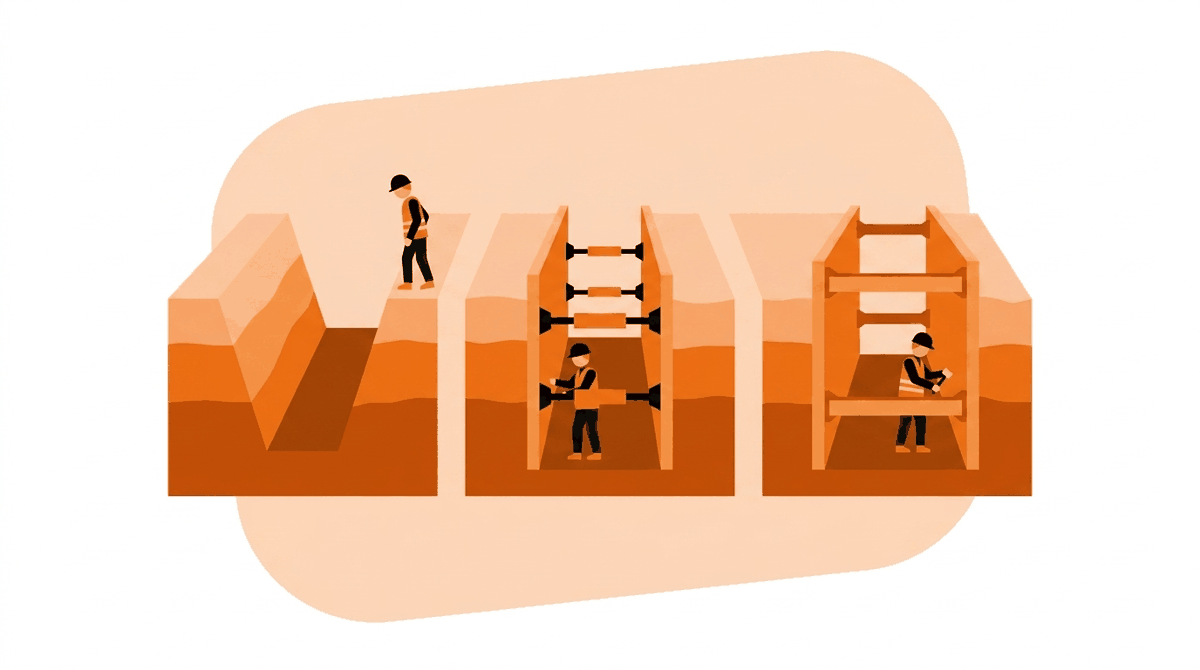
- Protect at 5 feet. Every trench 5 feet or deeper must have a protective system unless it is cut entirely in stable rock (1926.652(a)(1)). Deeper than 20 feet, a registered professional engineer must design it.
- Slope it, shore it, or shield it. The three accepted protective systems: slope or bench the walls back, shore them with supports, or shield workers with a trench box.
- A way out within 25 feet. Trenches 4 feet or deeper need a ladder, ramp or steps within 25 feet of lateral travel for every worker (1926.651(c)(2)).
- Spoils 2 feet back. Keep excavated soil, materials and equipment at least 2 feet from the edge (1926.651(j)(2)).
- Daily competent person inspections. A competent person must inspect the excavation before each shift, after rain, and after anything that could change conditions (1926.651(k)(1)) — with authority to pull workers out.
- Locate utilities first. Underground utilities must be located and marked before digging (1926.651(b)). Call 811.
OSHA’s message is three words: Slope It. Shore It. Shield It.
Trenching and excavation hazards
Cave-ins are the deadliest hazard, but not the only one:
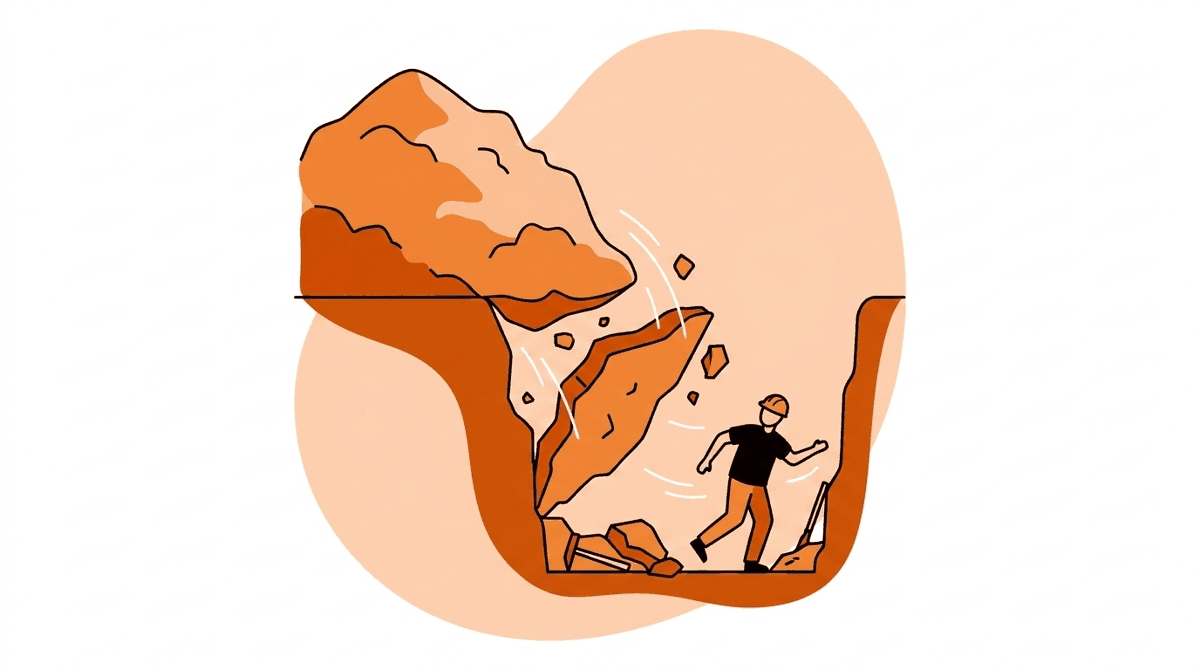
- A crew digs a 6-foot trench. The soil “looks solid,” the trench box is back at the yard, and a worker hops in to connect one fitting. The wall calves off in a single slab.
- It rained overnight. Yesterday’s inspection is worthless, nobody re-inspects, and the saturated wall fails mid-morning.
- Spoils are stockpiled right at the edge, surcharging the wall and rolling loose material onto the workers below.
- A trench cuts across an unmarked gas line. One bucket strike fills the excavation with gas.
- Water accumulates in the bottom and undercuts the walls — exactly how the Atlantic Drain workers died.
- A worker at the far end of a 100-foot trench has no ladder within reach when the wall starts to slough.
Trenching and excavation toolbox talk
Before anyone gets into a trench today, think about one number: 3,000 pounds. That’s roughly what one cubic yard of soil weighs. When a wall fails, several yards of it land on you faster than you can react. People buried only to the waist have died — the pressure alone stops your blood flow and your breathing.
So here are our non-negotiables.
One: no entry into any trench 5 feet or deeper without a protective system — sloped walls, shoring, or a trench box. I don’t care if it’s a 90-second task. The dirt doesn’t know how long you plan to be down there.
Two: the competent person inspects the trench before every shift, and again after rain, vibration, or any change. If you haven’t heard that today’s inspection happened, ask. If conditions change during the day — water seeping in, cracks along the edge, soil raveling off — get out and report it.
Three: know your way out. There must be a ladder or ramp within 25 feet of where you’re working. Find it before you start, not when the wall starts moving.
Four: keep the edge clean. Spoils, pipe, plates and equipment stay at least 2 feet back. And nobody works under a suspended load or an excavator bucket — that’s a line-of-fire hazard on top of everything else.
Last thing: if you see someone in an unprotected trench, get them out. And if a collapse ever happens, do not jump in after them — call 911 and start the rescue from outside. More than one rescuer has been killed by the second collapse.
The trench box is heavy and slow to set. Dig-outs are slower. Funerals are slowest of all.
Questions to employees
Ask your crew — a quick check that the talk landed:
- At what depth does OSHA require a protective system in a trench?
- What are the three types of protective systems?
- How far can you be from a ladder or other exit inside a trench?
- How far back from the edge do spoil piles and equipment have to stay?
- What conditions require the competent person to re-inspect the trench?
- What should you do if you see a coworker in an unprotected trench?
Promote trenching and excavation safety with this email template
Hi [Name],
Before our excavation work continues this week, our absolute rules for trench safety:
- No one enters a trench 5 feet or deeper without a protective system — sloping, shoring or a trench box. No exceptions, no “quick tasks.”
- The competent person inspects the trench before each shift and after any rain or change in conditions.
- A ladder or exit within 25 feet of every worker in the trench.
- Spoils and equipment stay at least 2 feet back from the edge.
Trench collapses kill workers every year doing exactly our kind of work. If anything about an excavation looks wrong, stop work and call me directly.
Stay safe,
[Your Name]
Conclusion
Every trench fatality follows the same pattern: an unprotected excavation, a worker who was only going to be in there a minute, and soil that gave no warning. The rules are short — protect at 5 feet, inspect daily, exit within 25 feet, keep the edge clear — and they work every time they’re used. No pipe and no deadline is worth being buried for.
References and Further Reading
- OSHA — Trenching and Excavation
- 29 CFR 1926.651 — Specific excavation requirements
- 29 CFR 1926.652 — Requirements for protective systems
- DOL/OSHA news release — enhanced enforcement after 2022 trench deaths
- Revoli Construction trench collapse — our coverage
- Atlantic Drain trench deaths and manslaughter conviction — our coverage